Danielle M.Google review
His knowledge of pitching, positive approach, and genuine commitment to the long-term health and arm care of young pitchers really sets him apart.
A full hour, $80, always with arm care built in. Pitching is always the full hour, because an arm needs that long to warm up properly and still get work in.
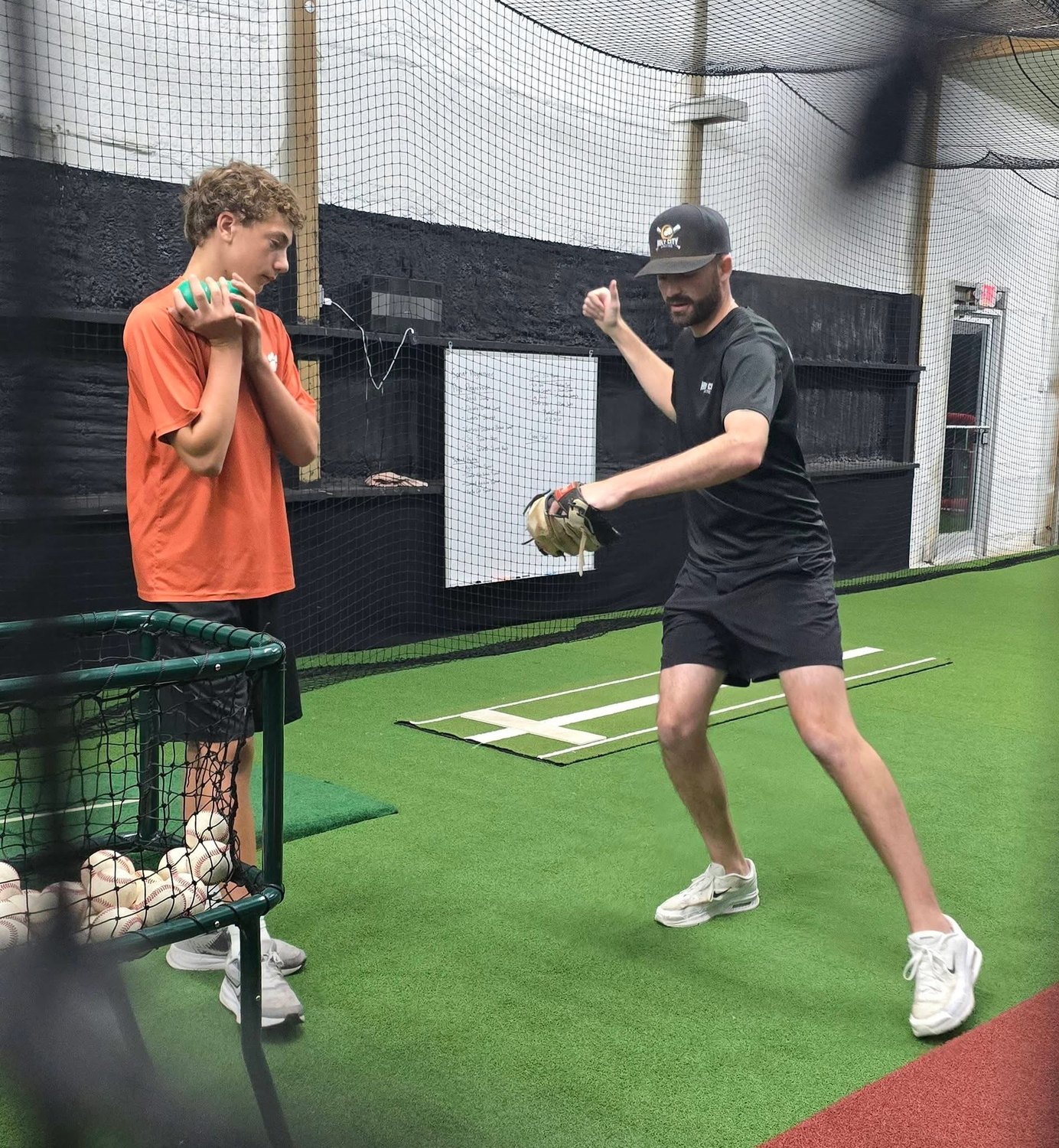
Jacob's own playing career ended with a throwing problem he had to rebuild his way out of, and that experience is the basis for how pitchers train here. In his words:
"The problem with pitching is, if you just pitch, you turn into a robot. You're always trying to tweak these little finite mechanics, and you get really sticky in some positions. One thing goes wrong, and you fix three other things, and all of a sudden that changes another problem."Jacob Fisher
So a pitching hour here starts with movement, and the mound comes after. Athleticism first, then arm care and a throwing routine, then the delivery work, then a cool down. Kids learn why each piece matters, because the only way a pitcher learns to fix himself mid-game is to understand what is actually happening.
If a kid is between teams, we will say to go play before buying more training. Baseball IQ comes from games, where a kid gets the chances to fail that a cage is too controlled to give him. Train here, compete out there.
The main number is strike percentage, and we keep it pitch by pitch. If a kid throws a four-seam and a changeup, he has a strike percentage for each one plus an overall. That is how we tell whether a change is working.
We watch velocity and let it come. A 12-year-old here throws at an effort he can repeat. We watch whether his average speed is climbing while he throws at normal effort, because that means he is getting into better positions. In our experience the velocity comes along on its own once the strikes and the movement are there.
We also follow how players do in games on Game Changer, so what we work on in a lesson lines up with what is happening on Saturday.
Pitches are added one at a time, and only after the one before it is working. A 10-year-old throwing his first lesson here learns a four-seam fastball and nothing else.
Breaking balls wait until a kid is physically mature enough to throw one, and 12 or 13 is the youngest we will go. It depends on the kid, so some 13 and 14 year olds are still waiting on one here.
Plenty of 10 to 12 year olds are taught a curveball because it gets outs that season. It works for a while, and then it stops working, because the curveball only works on top of a fastball they skipped. Jacob said this to a 12-year-old who was unhappy about waiting:
"You're going to get hit around now, but trust me, when you're 15 and you have a fastball that you can put anywhere, your curveballs can work so much better."Jacob Fisher
His knowledge of pitching, positive approach, and genuine commitment to the long-term health and arm care of young pitchers really sets him apart.
Jacob is great! He is patient and knowledgeable and has the ability to breakdown the art (and science) of pitching into chunks that are easy for a young person to understand.
Coach Jacob has been fantastic with our seven year old, and we're looking forward to many more lessons with him!